
Introduction
New Zealand reached a watershed moment in Islamic education in 2020: a full-time, residential girls’ Darul Uloom opened its doors in Auckland. Darul Hidayah lil Banat — “the House of Guidance for Daughters” — is New Zealand’s first institution of its type, offering the highest level of formal Islamic education for women in a country where no such provision previously existed.
The Gap That Darul Hidayah Fills
Before 2020, a New Zealand Muslim family wishing to give their daughter a formal, structured higher Islamic education had no domestic option. The only pathways were either to send a daughter overseas — to Pakistan, India, South Africa, or the United Kingdom — or to accept that she would remain without the deep Islamic scholarly training that her brother might access more easily.
The overseas route was expensive, logistically complex, and meant families were separated for years at a time. For some families it remained the only option; for many others it was practically impossible. The result was a systemic gap: New Zealand Muslim communities were producing few female Islamic scholars, and those scholars who did emerge often did so through personal initiative and international study rather than institutional support.
Darul Hidayah addresses this gap directly. Situated in Epsom — one of Auckland’s established residential suburbs, accessible by public transport — it provides the institutional infrastructure for serious Islamic education for girls without requiring families to send daughters overseas.
What Darul Hidayah Offers
The Alimah Course — Five Years
The flagship programme is the five-year Alimah course — a full Alimiyyah curriculum in the Darul Uloom tradition:
Subjects covered:
- Quran: Tafseer (exegesis), Tajweed (recitation science), Translation
- Hadith: Prophetic traditions and their sciences
- Fiqh: Islamic jurisprudence, covering the full range of practical Islamic law
- Related Islamic sciences at the depth required for scholarly authorisation
Graduates receive a formal qualification authorising them to teach Islamic sciences — an ijaza from their teachers, placing them within the chain of Islamic scholarly transmission. This qualification is recognised within the global Deobandi scholarly community.
Five years is a significant commitment. The programme is full-time and residential — students attend Monday through Friday in a structured daily programme. This intensity is what produces scholarship: the same subjects taught in a weekend maktab over twelve years are covered in depth in five years of full-time study.
The I’dadiyyah Course — One Year
For students who are interested in the Alimah course but lack the foundational preparation, the one-year I’dadiyyah (preparatory) course provides the entry point. It covers:
- Basic Islamic teachings
- Quran recitation to the required standard
- Preparation for the first year of Alimiyyah
This preparatory year performs two functions: it prepares students academically, and it allows them to experience the institutional environment and full-time study mode before committing to five years.
Basic Fundamentals — Short Course for Sisters 10–25
Not every woman seeking Islamic education is seeking the full Alimah qualification. The Basic Fundamentals course serves sisters aged 10–25 who want a structured, accessible introduction to core Islamic knowledge without committing to full-time study:
- Basic Aqaid (Islamic creed)
- Spirituality
- Laws pertaining to females (the rulings that specifically apply to women — purity, prayer, fasting, clothing, and related topics)
- Tajweed
- Du’as (supplications — practical daily prayers)
- Hadith selection
This short course is particularly valuable for older teenagers and young adults who completed their basic maktab education years ago and want to refresh and deepen their knowledge before marriage, higher education, or professional life.
The Boarding and Lodging Model
Darul Hidayah is not just a school — it is a residential institution. This boarding model is fundamental to the Darul Uloom tradition and makes the institution genuinely accessible to students from beyond Auckland.
Accommodation: Students live on-site in shared rooms, each with bathroom and toilet facilities. The environment is structured to support full-time Islamic study — not simply a place to sleep, but a community of students and teachers living and learning together.
Meals: Three meals daily (breakfast, lunch, dinner), provided by the institution.
Laundry: A laundry service is available for students, with the requirement that clothing be labelled with the student’s name in legible ink.
Tuck-shop: A privately run tuck-shop opens at lunch, after Asr, and after Esha.
This residential model means that a student from Hamilton, Christchurch, Wellington, or even the Pacific Islands can attend Darul Hidayah without requiring her family to relocate to Auckland. It also means that the institution takes on full-time pastoral responsibility for its students — a significant commitment that goes well beyond the academic.
Comparison with Australian Women’s Islamic Education
Darul Hidayah lil Banat (Auckland, NZ) and Madrasa Fatima Azzahra (Fawkner, Melbourne, AU) are the two premier women’s Islamic higher education institutions in the Pacific region, and comparison between them is instructive:
| Feature | Darul Hidayah (NZ) | Madrasa Fatima Azzahra (AU) |
| Founded | 2020 | 2021 (as MFA) |
| Location | Epsom, Auckland | Fawkner, Melbourne |
| Programme length | 5 years (Alimah) | 6 years (Alimah) |
| Tradition | Deobandi | Deobandi |
| Boarding | Yes | No (non-residential) |
| Students | Not publicly stated | Not publicly stated |
| Australian Alimahs produced | N/A | 96 as of 2025 (through chain incl. MFA predecessors) |
| Founding lineage | NZ Deobandi ulama | Ustadha Sajida Abid Faruqi (Karachi) |
Both institutions are products of the same broader Deobandi tradition; both are explicitly committed to producing qualified female Islamic scholars in their respective countries.
Why Darul Hidayah Matters for the Broader NZ Islamic Education Ecosystem
The existence of Darul Hidayah has ripple effects that go beyond the students who attend it:
Local Alimah supply. New Zealand’s mosque maktabs, weekend schools, and community Islamic education programmes are chronically short of qualified female Islamic teachers. A maktab that wants a female teacher for girls’ Quran classes, or a community centre that wants a qualified woman to lead women’s Islamic studies circles, currently has very few locally-trained options. As Darul Hidayah graduates its first cohorts of Alimahs, that supply will gradually improve.
Role models. The most powerful influence on a young Muslim woman’s decision to pursue Islamic scholarship is seeing other Muslim women who have done so. An Auckland Alimah who studied at Darul Hidayah and now teaches in Auckland is a more legible role model for a 16-year-old Auckland girl than a scholar who studied in Karachi or Jeddah.
Fatwa and guidance for women. Community questions about women’s Islamic law — menstruation and prayer, marriage and divorce, inheritance, dress, and many other topics that are best addressed by female scholars — are poorly served by an all-male scholarly leadership. Female Alimahs trained at Darul Hidayah will eventually provide this service in New Zealand communities.
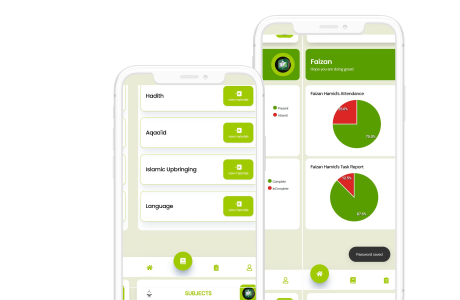
Management needs. As Darul Hidayah grows, its administrative complexity grows with it. A residential institution managing 20+ boarding students, three distinct programmes, fee structures, parent communication, and student progression records needs administrative systems proportionate to that complexity. The privacy of student data — particularly for minors in a boarding environment — falls squarely within New Zealand’s Privacy Act 2020 obligations.


 at
at