

Introduction
The Australian National Imams Council (ANIC) is the only national organisation representing Muslim imams, Shaykhaat, and Islamic scholars in Australia. With over 300 registered imams across eight state councils, ANIC occupies a unique position in Australian Islamic institutional life — but its relationship to Islamic education is more complex, and more significant, than many Australian Muslims realise.
What ANIC Is and What It Does
ANIC was established as a representative body for Australian imams following the recognition that Australia’s Muslim community lacked a credible national voice for Islamic scholarly leadership. Its primary mission is “to provide religious leadership, rulings and services to the Muslim community” — to strengthen Islamic identity through organised religious leadership, training, and services.
ANIC’s governance structure includes:
- A national executive and advisory team
- Eight State Imams Councils (ACT, NSW, NT, QLD, SA, TAS, VIC, WA) — the grassroots membership layer through which imams join ANIC
- An Australian Fatwa Council — chaired by the Mufti of Australia, with qualified imams in Islamic jurisprudence from all states — addressing fatwas on contemporary issues affecting Australian Muslims
- A Women’s Advisory Council (AWAC) — providing female representation in ANIC governance
ANIC’s founding Grand Mufti was Dr Ibrahim Abu Muhammad, who held the position from 2011 onwards. In March 2024, AFIC (the Australian Federation of Islamic Councils) separately appointed Sheikh Riad El-Rifai as Grand Mufti — creating two competing holders of the title as previously documented. ANIC, however, continues to operate its own Fatwa Council under its own scholarly leadership.
ANIC’s Direct Contributions to Islamic Education
ANIC’s impact on Islamic education operates through several channels:
1. Australian Islamic Education Services (AIES)
ANIC has established Australian Islamic Education Services (AIES) — website: islamiceducation.org.au — as a dedicated subsidiary focused on the Islamic education sector. AIES is a not-for-profit organisation described as “an Australian National Imams Council initiative dedicated to the provision of services in the Islamic education sector.”
AIES operates specifically in the space that falls between ISAA’s full-time school focus and the mosque maktab/madrasah sector — providing services to community Islamic education providers that lack the resources of ISAA member schools.
2. The Al Nawawi Centre — Sydney
ANIC’s Grand Mufti Dr Ibrahim Abu Muhammad is the head of the Al Nawawi Centre — described as “an unprecedented vision: a multi-purpose community mega-centre to lead Australia’s Muslims into a new era.” Named for the great medieval Islamic scholar Imam Nawawi, the centre aims to be a game-changing institution for Sydney’s Muslim community.
Islamic Relief Australia is the principal partner and initial contributor to the Al Nawawi Centre project. The centre takes its inspiration from the intellectual tradition of Islam to offer “rays of hope, renewal, and unity” for the Muslims of Sydney and Australia generally.
The Al Nawawi Centre represents a vision of Islamic institutional infrastructure that goes well beyond a simple mosque or madrasah: a comprehensive community hub that integrates Islamic scholarship, education, welfare services, and community development. Whether and when the centre is fully realised will significantly shape the trajectory of Islamic education in New South Wales.
3. The Australian Fatwa Council
The Australian Fatwa Council focuses on fatwas on contemporary issues and matters pertaining to Australian Muslims. For Islamic education, this is directly relevant: questions about what can and cannot be taught in Islamic schools, the status of state curriculum requirements relative to Islamic law, the permissibility of various school management practices, and the Islamic validity of financial arrangements (including school fee structures) are all subjects on which the Fatwa Council can provide guidance.
The Council is chaired by the Mufti of Australia and includes imams qualified in Islamic jurisprudence from all Australian states — giving its fatwas a genuinely national geographic representation.
4. ANIC’s State Imam Networks and Local Education
ANIC’s 300+ registered imams are active in the day-to-day affairs of the Islamic community. The vast majority of Australia’s mosque maktabs and weekend Islamic schools are led or supervised by imams. The quality, training, and commitment of those imams determines the quality of Islamic education at the grassroots level.
ANIC provides these imams with professional networks, training, and access to scholarly resources. An imam in Darwin (ISOD madrasah) or Rockingham WA (Ar-Rukun mosque), or in outer-suburban Brisbane (Slacks Creek masjid), operates in relative isolation from the national Islamic scholarly community. ANIC’s state councils and national network reduce that isolation — providing a channel for professional development, fatwas on local questions, and connection to the broader Australian Muslim scholarly community.
5. ANIC’s 2025 Security Uplift Programme
ANIC administers the Security Uplift for Muslim Communities in Australia Program — a $25 million Australian Government investment over three years through the Department of Home Affairs’ Office for Multicultural Affairs. This programme provides security infrastructure (physical security systems, assessments, improvements) to Muslim faith-based places including mosques, schools, Islamic centres, and other community facilities.
For Islamic schools and mosque maktabs, this is directly relevant: security upgrades at mosque premises where maktabs operate, and at Islamic school buildings, are partially funded through this programme. An Islamic school’s decision to install CCTV, improve perimeter security, or implement electronic access control can benefit from ANIC’s administration of this programme.
ANIC’s Recent Public Role and the Education Community
ANIC’s most visible public interventions in 2025–2026 have centred on community safety and Islamophobia rather than educational policy — but these public positions directly shape the environment in which Islamic education operates.
January 2026: ANIC condemned a white supremacist hate crime against a Victorian imam and his wife — a direct attack on the type of imam who typically leads a community maktab or teaches Islamic studies. The condemnation signalled that religious leaders face personal safety risks that the broader Muslim educational community needs to be aware of.
December 2025: ANIC issued statements on the Bondi attack and related legislative proposals — contributing to public discourse about Muslim community rights and freedoms in a period of significant social tension.
These public positions matter for Islamic education because Muslim families making decisions about whether to send their children to Islamic schools, and Islamic schools making decisions about how visibly to identify themselves, are doing so in a social and security context that ANIC actively monitors and responds to.
ANIC vs AFIC: The Governance Landscape Islamic Educators Need to Understand
Islamic school and maktab leaders in Australia operate within a governance landscape shaped by the division between ANIC and AFIC:
AFIC (Australian Federation of Islamic Councils) is the older body, founded 1964, with direct governance over some Islamic schools and a state council structure. Its March 2024 appointment of Sheikh Riad El-Rifai as Grand Mufti created the competing appointment with ANIC’s Dr Ibrahim Abu Muhammad.
ANIC is the imams’ body — representing the scholarly leadership community rather than the community governance boards. Its educational arm (AIES) focuses on the educational sector as such; its Fatwa Council provides scholarly guidance; its state networks connect local imams.
For an Islamic school board or maktab management committee, understanding which body has authority in which domain matters for practical decisions: AFIC’s state councils may have direct governance relationships with affiliated schools; ANIC’s Fatwa Council is the authoritative source for Islamic scholarly guidance on educational questions; ISAA is the operational peak body for full-time school management.
What ANIC Does Not (Yet) Provide
Despite its significant reach and resources, ANIC does not yet offer:
Standardised imam training with an educational credential: Imams currently obtain their training from the institutions they attended overseas or domestically — there is no Australian-wide imam training programme leading to a recognised qualification. This has direct consequences for Islamic education quality: the imam who leads the local maktab may be deeply qualified or barely qualified, and there is no Australian credential that distinguishes one from the other.
A national curriculum framework for mosque madrasahs: AFIC/ISAA governs full-time schools; ANIC does not currently provide an equivalent curriculum framework for Australia’s hundreds of mosque maktabs and weekend schools. Each institution independently sources its curriculum (Tasheel Series, An-Nasihah, Safar, IQRA, or home-developed), with no national quality standard.
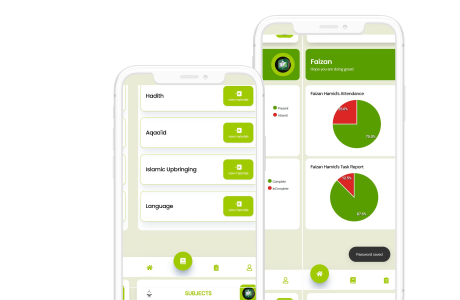
Digital management infrastructure for the maktab sector: ANIC’s institutional focus is on imams, fatwas, community services, and advocacy. It has not (to date) created a national digital infrastructure for managing the administrative needs of mosque madrasahs — student records, attendance, Hifdh tracking, fee management, parent portals.
These gaps represent genuine opportunities for the Australian Islamic education sector — whether through expanded ANIC/AIES initiatives, ISAA engagement with the non-school sector, or purpose-built solutions for the specific needs of community Islamic education providers.


 at
at