

Introduction
After-school timing is one of the most consequential decisions an Australian maktab makes. Get it right and students arrive, engaged, and ready. Get it wrong and enrolment suffers — not because the curriculum is poor but because the logistics don’t work for Australian families with full-time working parents, busy school schedules, and long commutes.
This article analyses how established Australian maktabs have structured their programme timing, drawing on documentation from nine institutions across five states.
The After-School Window: 4:00pm to 7:00pm
The standard after-school window for Australian maktabs is approximately 4:00pm to 7:00pm. Schools dismiss at 3:00–3:30pm, after-school care (OOSH) runs until 6:00pm in many areas, and families with young children typically want children home by 7:00pm for dinner and homework. This creates a functional window of about three hours — not all of which is usable.
Why 4:30pm is the Most Common Start Time
Multiple Australian maktabs start at 4:30pm:
- Iqra Academy Australia (Slacks Creek, QLD): Monday–Thursday, 4:30–6:30pm
- Madrasahtul Islamiyah (Wellington, NZ): Monday–Friday, 4:30–6:00pm
- YMA Quran Maktab (Sydney): varies by session but follows after-school model
The 4:30pm start allows:
- 30–60 minutes after school dismissal (3:00–3:30pm) for travel
- A snack period for younger students
- Arrival at the mosque without rushing
Starting earlier than 4:30pm requires students to be picked up from school early or travel directly from school without going home — which creates logistical pressure on families and on the children themselves.
Why 6:30pm is the Common End Time
Finishing at 6:30pm gives families time for dinner before 7:00pm. This is important because:
- Dinner is often a family event; children who arrive home at 7:30pm disrupt family rhythm
- Children who attend maktab until 7:30pm then eat at 8:00pm then do school homework are likely fatigued
- Magrib prayer falls in the 6:00–7:00pm window in Australian cities — finishing at 6:30pm allows students (and teachers) to pray Magrib
The 4:30–6:30pm model (2 hours) is the most balanced for after-school maktabs in terms of both logistics and programme depth.
The Saturday School Model: 10am to 1pm
Several institutions that cannot operate on weekdays, or choose not to, run weekend programmes. The Saturday (or Sunday) model is the alternative mainstream option.
Darul Uloom Islamic Academy, Brisbane: Saturday 10:00am–1:00pm
Imam Quddoos’ Brisbane madrasah runs on a single Saturday per week, 10:00am–1:00pm, three quarters per year (except Ramadan). The 3-hour session is divided:
- Quran recitation
- Islamic studies
- Du’a and Surah memorisation
- 15-minute tea break
The 10am start is later than necessary — students don’t need to rush, parents can do morning household tasks first, and the family sleep-in is not completely sacrificed. The 1pm finish frees the afternoon for family activities, leaving Saturday afternoon and Sunday free.
Limitation: One 3-hour session per week produces approximately 36 sessions per year (three quarters × 12 sessions per quarter = 36). Compare to a daily after-school programme running 5 days × 45 weeks = 225 sessions per year. Saturday-only programmes cover approximately 1/6 the contact time of daily programmes.
Young Muslims of Australia (YMA), Sydney: Sunday and Saturday Models
YMA operates two distinct weekend programmes:
- Sunday Madrasah: Prep to Year 10 — the main children’s madrasah
- Saturday Madrasah: Year 10+ — older students with Ustadh Mahmud
Splitting the student body by age across two days allows age-appropriate teaching environments without managing all age groups simultaneously. Older students on Saturday can engage with more demanding content at greater depth; younger students on Sunday can have a more structured, supervised programme.
The Islamic Society of Darwin: Saturday 9:45am to 1:00pm
ISOD’s Darwin madrasah starts slightly earlier than most Saturday programmes — 9:45am — and runs until 1:00pm (3 hours 15 minutes). This timing allows:
- Full session completion before early afternoon heat
- Students and families to observe Dhuhr prayer together before the session ends
- Community connection time after the session
Darwin’s unique geography and climate shape its timetabling. The Vanderlin Drive mosque serves a scattered Muslim community; arriving by 9:45am requires some families to drive 30+ minutes. An earlier start ensures maximum programme time while still finishing before the peak Saturday afternoon heat.
The Full-Week After-School Model: Monday to Thursday
Iqra Academy’s Monday–Thursday after-school model (4:30–6:30pm) is the most intensive weekday programme among documented Australian maktabs. Why four days and not five?
Friday is excluded for practical reasons:
- Many Australian workplaces release early on Fridays
- Jumuah prayer affects Friday schedules for Muslim families
- Friday is commonly a social and religious day — families may have Jumuah obligations, dinner gatherings, or other commitments
- Teachers, many of whom have other commitments, appreciate the Friday break
Four days × 2 hours = 8 hours per week of Islamic education. Over a school year of approximately 40 weeks (excluding holidays), this is approximately 320 hours of contact time per year. Compare this to a school that provides 6 hours per week of Islamic studies (a full-time Islamic school) — the maktab provides roughly half the annual Islamic education contact time of a full-time school, from a community programme. This is a significant achievement.
The Islamic Society of Darwin: Term Calendar Alignment
ISOD explicitly aligns its madrasah calendar with the Northern Territory school calendar — starting when NT schools start (typically late January) and taking breaks when NT schools take breaks. This school-aligned approach:
- Reduces conflict with family holiday planning
- Prevents asking teachers to work when families are away
- Makes scheduling predictable for parents
All of the New Zealand maktabs documented — Madrasahtul Islamiyah Wellington, Madrasah Uthmaaniyah Auckland, and Northland Islamic Center’s Madrasah Ta’aleem — similarly align with the NZ school term calendar.
Alignment with the school calendar creates the “three-quarter” or “four-term” structure common across documented institutions:
- Darul Uloom Brisbane: “three quarters per year, each comprising 3–4 months”
- Madrasahtul Islamiyah Wellington: “four terms per year… classes will start and finish as NZ School Term”
Online and Hybrid Scheduling
Online programmes have different scheduling pressures. Ulul Albab Islamic Institute (Northland, NZ) runs:
- Quran/Qa’idah individual slots: Monday–Thursday, 5:00–8:00pm (15-minute individual time slots)
- Islamic Studies group classes: Every second Friday, 6:15–7:30pm
The 15-minute individual slot model for Quran is necessary for online delivery — unlike a classroom where all students can practice simultaneously while the teacher circulates, online individual Quran lessons require dedicated one-to-one time. Scheduling 10–20 students in 15-minute slots across the 5:00–8:00pm window allows the teacher to give each student focused, audible attention.
The fortnightly Friday Islamic Studies session (every second Friday, not every Friday) acknowledges that families with children have competing Friday commitments. Every fortnight is achievable; every week is a barrier to consistent participation.
Scheduling Considerations for Ramadan
Most Australian maktabs suspend operations during Ramadan or reduce their schedule significantly. Darul Uloom Brisbane explicitly notes “except for the month of Ramadan” in its Saturday schedule.
The reasons are practical: during Ramadan, families’ schedules change dramatically. Iftar preparation occupies the late afternoon. Children fasting for the first time may struggle with after-school energy levels. Teachers and imams are occupied with Tarawih and Ramadan programmes. The community’s attention is on spiritual renewal rather than structured education.
Some institutions convert Ramadan into an intensive short-course period — daily Quran completion recitals, special Hifdh review sessions, or Ramadan Islamic education focused on fasting, Zakaat, and Ramadan Fiqh. But the standard weekday after-school or Saturday madrasah typically pauses.
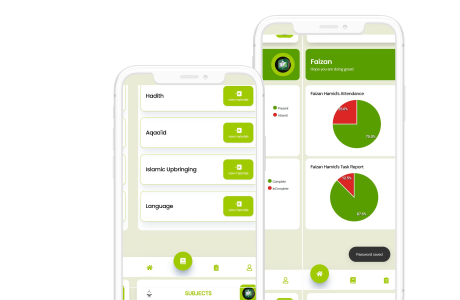
Scheduling management implication: A maktab management system needs to handle Ramadan scheduling — either automated holiday periods aligned with the Islamic calendar (which shifts annually relative to the Gregorian calendar), or manual term configuration allowing administrators to pause and resume the term calendar across Ramadan each year.
The Management Implications of Scheduling Data
Every scheduling decision generates management data:
Attendance vs schedule: If a student misses three consecutive sessions, the teacher or administrator needs to follow up. For a 4-day-per-week programme with 50 students, this generates 200 potential daily attendance events to track.
Teacher scheduling: When teachers are absent, substitutes are needed. Without a teacher schedule and substitute list in a digital system, coverage decisions rely on emergency WhatsApp messages.
Holiday scheduling: Australian state school holidays differ by state and year. A maktab calendar aligned with the school calendar needs annual updating — and parents need advance notice of the madrasah term dates.
Ramadan date variation: The Ramadan pause shifts each year. A management system that hardcodes calendar dates becomes inaccurate as the Islamic calendar moves. Dynamic Ramadan handling requires either manual configuration or Hijri calendar integration.
Make-up classes: When a Saturday session is cancelled due to a public holiday or community event, does the programme offer make-up sessions? Managing make-up classes — communicating them, tracking attendance at them, recording which students attended — requires a system that can handle exceptions to the standard schedule.
None of this is theoretically complex. But in a maktab managed with a notebook register, a WhatsApp group, and the imam’s memory, it becomes the source of constant administrative friction. The students and families pay the cost of that friction in missed sessions, unclear schedules, and institutional inconsistency.


 at
at