
Introduction
Australia has a growing ecosystem of formal Islamic education for women — from short introductory courses to six-year Alimah programmes that authorise in the sacred sciences. What exists today represents a genuine achievement: a generation of Australian-born women trained to the highest standards of traditional Islamic scholarship, able to teach, give fatwa, and lead Islamic education within their communities. This article documents that ecosystem in detail.
The Historical Gap and How It Was Filled
For most of Australian Islamic history, women seeking serious Islamic education had two options: travel overseas to study (to Pakistan, India, Egypt, Saudi Arabia, or South Africa), or make do with informal learning from local imams and women’s circles. Neither was satisfactory. Travel was prohibitively expensive and not universally accessible. Local learning was unstructured, of variable quality, and rarely produced women qualified to teach.
The change came from South Africa via a remarkable chain of scholarship. The late Ustadha Sajida Abid Faruqi — granddaughter of Pakistan’s former Prime Minister Chaudhry Muhammad Ali — founded Madrasa Ayesha Siddiqua in Karachi in the late 1980s. She was the first person in Pakistan to build a systematic programme for females mastering Arabic alongside the main Islamic sciences. Ustadha Sajida completed her studies under Shaykh Abdur-Rashid Nu’mani and Shaykh Muhammad Anwar Badakhshani, and specialised in Islamic jurisprudence and ifta’ under Mufti Taqi Usmani. One of the most significant decisions of her life was, a few weeks before her passing in early 2021, to initiate Madrasa Fatima Azzahra in Melbourne — entrusting its establishment to her students already working in Australia.
The statistics that emerged from that chain of transmission are remarkable: as of 2025, 96 female Alimahs have graduated through the Deobandi methodology in Australia. All were trained either directly by Ustadha Sajida’s students or by their students in turn. This is a traceable, documented scholarly lineage — an isnad for Australian women’s Islamic education.
Madrasa Fatima Azzahra (MFA Institute) — Fawkner, Melbourne
Address: 43 Elizabeth Street, Fawkner VIC 3060
Contact: info@mfa-institute.org
Website: mfa-institute.org
Madrasa Fatima Azzahra is Australia’s leading institution for women’s formal Islamic education in the Deobandi tradition. Its programmes are led by three Alimahs — each formally trained in Islamic jurisprudence and ifta’ — who maintain the rigorous academic standards established by Ustadha Sajida.
Alimah Programme
Six-year full-time intensive programme authorising in the Sacred Sciences.
- Location: 43 Elizabeth St, Fawkner VIC 3060
- Days/Hours: Monday–Friday, 8:00am–12:45pm
- Subjects: Arabic language, Quran (Tafseer, Tajweed, Translation), Hadith, Fiqh, Aqeedah, Seerah, and Islamic jurisprudence including ifta’ (Islamic legal opinion)
This is the flagship programme and is in the direct Deobandi Alimiyyah tradition. Graduates receive an authorisation to teach in the Islamic sciences — a formal ijaza in the relevant subjects. The programme’s six-year duration mirrors the traditional Dars-e-Nizami structure adapted for the Australian context.
Fadila Programme
Two-year full-time Islamic Studies programme.
- Location: 43 Elizabeth St, Fawkner VIC 3060
- Days/Hours: Monday–Friday, 9:00am–12:00pm
The Fadila Programme provides a shorter pathway for women who want a formal, structured Islamic education without committing to the full six-year Alimah track. It covers the foundational sciences and provides the student with a solid working knowledge of Islamic studies.
Tafsir Halaqa
Free weekly Quranic study circle (Urdu)
- Location: 43 Elizabeth St, Fawkner VIC 3060
- Days/Hours: Thursdays, 1:00pm–2:50pm
Open to the broader community, this weekly circle provides accessible Quranic education in Urdu for women who may not be able to commit to the structured programmes. It also functions as a community connection point for MFA.
Admissions: MFA runs a WhatsApp channel for programme announcements. Contact info@mfa-institute.org for enrolment details.
Darul Hidayah lil Banat — Epsom, Auckland, New Zealand
Website: darulhidayah.co.nz
Though based in New Zealand, Darul Hidayah lil Banat is the regional equivalent of MFA and worth documenting here for comparison. It is explicitly described as New Zealand’s first full-time girls Darul Uloom — a girls’ boarding Islamic school in the full Darul Uloom tradition. Located in Epsom (Auckland), it began with a handful of students and teachers in 2020 and has grown significantly.
Darul Hidayah offers:
- Alimah Course — five years, covering Tafseer, Tajweed, Translation of Quran, Hadith, Fiqh, and related Islamic sciences
- I’dadiyyah Course — one year, preparing new students for the Alimiyyah first year, focusing on basic Islamic teachings and Quran recitation
- Basic Fundamentals — short course for sisters aged 10–25 covering basic Aqaid, spirituality, laws pertaining to females, Tajweed, Du’as, and Hadith
The school provides boarding and lodging for students from outside Auckland, including accommodation, meals (three times daily), and laundry service. This boarding model makes Darul Hidayah accessible to students from around New Zealand and the Pacific — not only Auckland.
Daar Aisha College — Condell Park (Western Sydney)
Address: 131 Eldridge Road, Condell Park NSW 2200
Phone: 0420 902 928
Email: info@daaraisha.org
Website: daaraisha.org
Daar Aisha College is “Australia’s Leading Islamic Educational Institute for Women” — a description it has earned over more than two decades of operation. Founded in 2003, it has processed over 11,000 student registrations from students representing 90+ nationalities. Its approach is distinct from the Deobandi Alimah tradition: it focuses on adult Islamic education through structured courses rather than a residential or full-time institutional model, making it accessible to working women, mothers, and recent converts.
2026 Programme Highlights:
Foundation and Introductory Courses:
- Islam for Beginners — the entry point for new Muslims and those building foundational knowledge
- Junior Shariah Course — for Muslim youth
Core Islamic Sciences:
- Shariah Course — the multi-year core curriculum covering Fiqh, Aqeedah, Hadith, and Tafseer
- Extended Course — a deeper immersion programme for advanced students
Quranic Studies:
- IQRA Quran College for Children (2026 registrations open)
- IQRA Quran College for Women (2026 registrations open)
- Part-Time Tahfiz Program — Quran memorisation with structured support
Seerah (Prophetic Biography):
- Seerah — The Biography of the Beloved (Makkah period)
- Seerah — The Radiant City (Madinah period, starting 7 February 2026)
Specialist Short Courses:
- The Fiqh of Zakaat al-Maal and Zakaat al-Fitr (one-day intensive, 1 March 2026)
- The Lawful and Unlawful in Islam
- The Khilafah of Imam Ali and Imam al-Hasan (Islamic history)
- Journey to Allah / Journey of Self-Discovery (Islamic spirituality)
Arabic Language:
- Introduction to Arabic (2026, pre-requisite required)
- Arabic Language Level 2 — “Words of Light” (Quranic vocabulary and grammar)
All courses are offered onsite and online, with recordings available. The relocated 2026 premises are at 131 Eldridge Road, Condell Park — an accessible Western Sydney location close to the large Bankstown/Lakemba Muslim population.
Testimonials highlight Daar Aisha’s distinctive approach: intellectual depth combined with spiritual renewal, taught in contemporary Australian English rather than the traditional South Asian pedagogical style. One student described it as “absolute spiritual and intellectual illumination.”
Masjid Qubaa (Women’s Islamic Education) — Mount Druitt, Western Sydney
Address: 19 Sunblest Crescent, Mount Druitt NSW 2770
Website: masjidqubaa.org.au
While Masjid Qubaa’s primary educational reputation is built on its comprehensive Quran and Shari’ah courses (including a full Six-Year Shari’ah Course), it implicitly serves women through its public programmes. The mosque was established by Dr Shabbir Ahmed, who has dedicated 32 years to the Western Sydney Muslim community, and offers educational programmes accessible to both male and female community members through structured courses.
Young Muslims of Australia (YMA) — Sydney
Website: yma.org.au
YMA has been operating for over 30 years and runs one of Sydney’s longest-established weekend madrasah programmes. While not exclusively for women, YMA offers a Quran Maktab (after-school) programme for girls, a Sunday Madrasah (Prep to Year 10) and a Saturday Madrasah (Year 10+), and a Weekend Knowledge Intensive programme. YMA is also raising funds to build the YMA Markaz — a permanent centre to anchor its education and community work.
Learn Quran and Arabic Centre — Clyde North, Melbourne (and online nationally)
Main branch: Clyde North VIC 3978
Website: learn-quran-and-arabic-centre.com.au
This centre, led by Dr Manzur Ashraf, provides online and face-to-face Quran, Arabic, and Islamic Studies education for both males and females. Female students are taught by qualified female teachers. The centre specifically addresses the reality of Muslim women in outer-suburban Melbourne who may not have access to local Islamic education: it offers national online delivery across NSW, VIC, QLD, TAS, SA, NT, WA, and New Zealand.
The centre’s pedagogy emphasises contextual meaning (understanding what the Quran says) alongside correct recitation — a deliberate departure from rote recitation-only approaches. The motto, “Be Proud of being a Muslim,” reflects a community-building as well as educational vision.
The Management Challenge in Women’s Islamic Education
Women’s Islamic education institutions in Australia face a distinctive set of management challenges:
Student diversity: With students from 90+ nationalities (as at Daar Aisha), or from across the South Asian diaspora (as at MFA), multilingual administration and parent/student communication is a baseline requirement, not an afterthought.
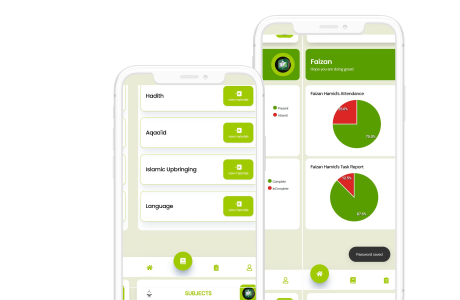
Online-offline hybrid delivery: Every major provider now offers online alongside onsite — but managing attendance, progression, and engagement across both modalities requires platforms beyond simple WhatsApp groups. Students who miss an online class need timely follow-up; progression in Hifdh or Shariah studies needs to be tracked regardless of whether the session was attended online or in person.
Formal record-keeping for Alimah graduates: When MFA graduates an Alimah, that graduation has lasting significance — the student’s qualification and the specific teachers she studied under form part of her scholarly credentials. These records need to be maintained institutionally, not in a single administrator’s email inbox.
Fee management for volunteer-run organisations: Most of these institutions rely heavily on volunteer teachers and community donations. Professional fee management — receipts, payment tracking, Zakat eligibility documentation for scholarship students — requires systems appropriate to a registered charity with 50–200 students, not a notebook.


 at
at